ATF Opens the Door to Unregistered Suppressors and Short-Barreled Firearms — But Could Today's Legal Owners Become Tomorrow's Felons?
ON TARGET NEWS DESK | OCTOBER 11, 2026
ATF Opens the Door to Unregistered Suppressors and Short-Barreled Firearms — But Could Today's Legal Owners Become Tomorrow's Felons?
By Scott Maurano | On Target News Desk
An unprecedented federal court ruling and a sweeping change in ATF enforcement policy have dramatically altered the National Firearms Act landscape. But behind the celebration among Second Amendment supporters lies a troubling question: What happens when the administration changes, the courts reverse course, or federal prosecutors decide to enforce the law again?
A Historic Change in Federal Firearms Enforcement
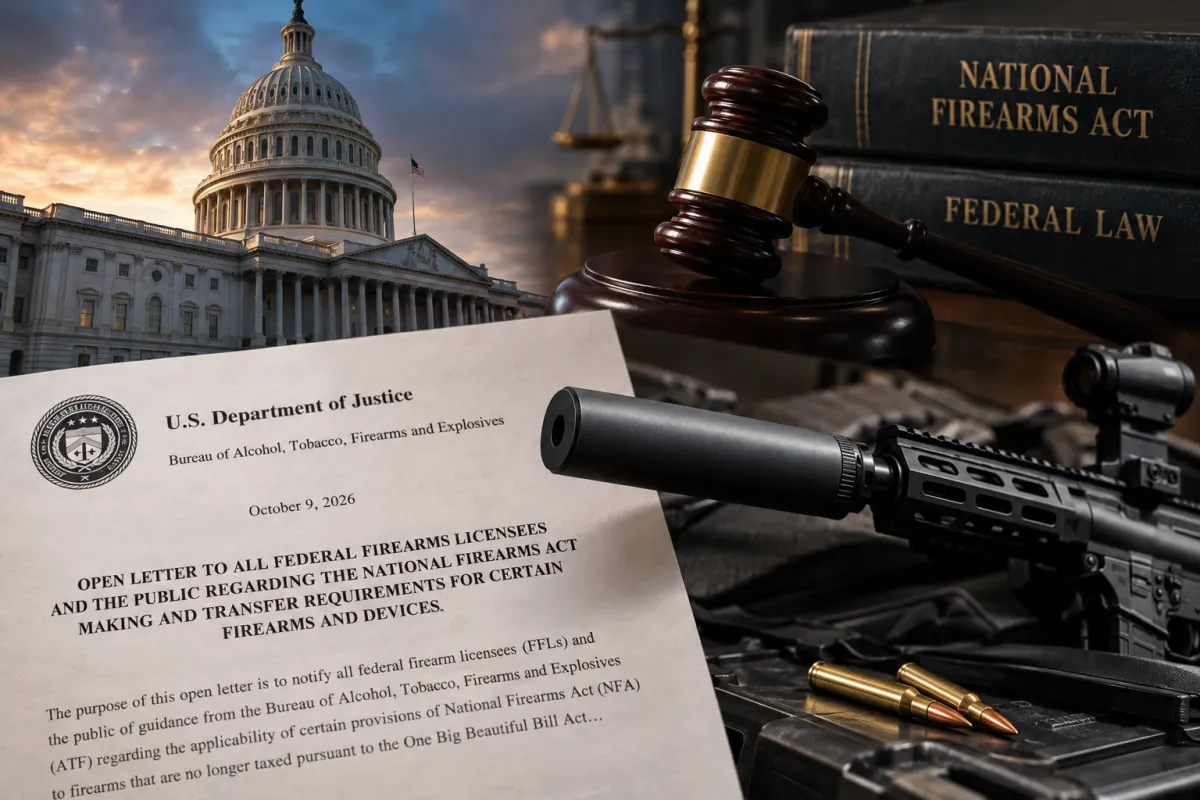
On October 9, 2026, the Bureau of Alcohol, Tobacco, Firearms and Explosives issued an extraordinary open letter announcing that it would no longer require federal approval or registration for several categories of firearms and devices historically regulated under the National Firearms Act (NFA).
The announcement represents one of the most consequential changes in federal firearms enforcement since the NFA was enacted in 1934.
Under the new policy, individuals are no longer required by ATF to obtain advance NFA approval or register certain firearms and devices, including:
Short-barreled rifles (SBRs)
Short-barreled shotguns (SBSs)
Firearm silencers and suppressors
Firearms classified as Any Other Weapons (AOWs)
For decades, acquiring or manufacturing these items generally required an ATF application, federal registration, approval, and payment of a transfer or making tax.
Now, according to the October 9 letter, the agency will allow those same items to be made or transferred without requiring NFA registration or approval, subject to other applicable federal and state laws.
The change follows a federal court decision that challenged the constitutional foundation of the NFA's registration system after Congress eliminated the making and transfer taxes on these particular firearms and devices.
However, the announcement contains a distinction that every firearm owner, dealer, and prospective purchaser should understand.
Congress has not repealed the NFA's registration and criminal provisions. Instead, the ATF has announced that it will stop enforcing certain provisions against specified categories of firearms.
That distinction could have enormous consequences in the future.
The Court Case That Started It All
The controversy centers on Silencer Shop Foundation v. ATF, Case No. 6:25-CV-056-H, decided by the United States District Court for the Northern District of Texas on August 5, 2026.
The case raised a fundamental constitutional question: If Congress eliminates the tax that originally supported the National Firearms Act, can the federal government continue requiring registration and approval under that same taxing authority?
The National Firearms Act was passed in 1934 during an era of intense public concern over organized crime and firearms violence.
Rather than simply banning particular firearms, Congress established a system of taxation, registration, and administrative approval. The federal government's constitutional justification rested heavily on Congress's authority to impose and collect taxes.
For decades, the NFA's $200 making and transfer taxes were central to that regulatory structure.
That foundation changed with the passage of the One Big Beautiful Bill Act in 2025.
Congress reduced the making and transfer taxes to zero dollars for suppressors, short-barreled rifles, short-barreled shotguns, and AOWs. Machine guns and destructive devices retained their $200 tax.
The plaintiffs in Silencer Shop Foundation v. ATF argued that removing the tax undermined the constitutional justification for continuing to impose registration and approval requirements on the newly untaxed items.
The federal district court agreed.
According to the ATF's October 9 letter, the court determined that registration and transfer requirements for these items could no longer be sustained as an exercise of Congress's taxing power when the applicable tax had been eliminated.
The court also rejected the government's alternative reliance on Congress's interstate commerce authority, reasoning that Congress had not relied on that authority when originally enacting the NFA in 1934.
The resulting injunction, effective August 12, 2026, prohibited ATF from enforcing specified NFA provisions against the plaintiffs and certain other covered persons for the firearms affected by the tax reduction.
Importantly, the injunction itself was not nationwide.
It was limited in scope, and it did not eliminate the underlying statutory provisions from federal law.
That limitation is essential to understanding the risks created by the ATF's subsequent announcement.
How a Limited Court Ruling Became a Nationwide Policy
Following the August ruling, the ATF received requests for clarification from firearm dealers, industry representatives, lawmakers, state attorneys general, and members of the public.
According to the agency, 47 members of Congress also requested that the court's decision be applied nationwide.
On October 9, the Department of Justice chose to go beyond the court's limited injunction.
Rather than enforce the NFA's registration and approval provisions against everyone except those protected by the lawsuit, the department announced that it would exercise its prosecutorial and administrative discretion uniformly.
Effective immediately, ATF would no longer require NFA approval or registration for the four affected categories of firearms and devices.
This was a major victory for supporters of reducing federal firearms regulation.
It also created a legal environment in which the practical rules governing ownership could be substantially different from the statutory language still contained in federal law.
The difference between those two things is where the controversy becomes particularly serious.
The Greatest Unanswered Question: What Happens Under the Next Administration?
Presidential administrations change. Attorneys general change. ATF directors change. Enforcement priorities change.
But federal criminal statutes do not automatically disappear simply because an administration announces that it will no longer enforce them.
The October 9 letter explicitly describes the new nationwide approach as an exercise of enforcement discretion.
It does not announce that Congress has repealed the applicable NFA provisions.
Nor does it establish a permanent statutory exemption for firearms acquired without registration under the new policy.
That creates a potentially dangerous situation for individuals who rely on today's federal guidance when making decisions that could affect them for the rest of their lives.
Imagine a firearm owner legally purchasing an unregistered suppressor in November 2026 under the newly announced federal enforcement policy.
The transaction complies with the applicable Gun Control Act requirements, including a background check and dealer recordkeeping.
The owner takes possession, retains the suppressor, and reasonably believes that everything has been handled in accordance with current federal guidance.
Several years later, a new presidential administration takes office.
The new attorney general disagrees with the previous administration's interpretation of the law.
The Department of Justice announces that it will once again enforce the NFA's registration and approval requirements.
The ATF rescinds or replaces the October 9, 2026, guidance.
The firearm owner now possesses an item that was never registered in the National Firearms Registration and Transfer Record.
What happens next?
The answer is far from certain.
Could a New Administration Reverse the Policy?
Yes. Because the nationwide policy is based on executive enforcement discretion rather than a congressional repeal, a future administration could attempt to reverse it.
A new administration could direct ATF to resume processing mandatory NFA applications and begin enforcing statutory registration requirements, subject to whatever judicial rulings remain binding at that time.
A new administration could also adopt a different legal interpretation of the district court's decision or pursue appellate litigation seeking to overturn it.
The Texas court's injunction would still protect those within its scope unless modified, stayed, or reversed. But the much broader nationwide nonenforcement policy does not carry the same judicial protection.
That distinction means millions of potential future transactions could depend on executive decisions rather than permanent changes to federal law.
For firearm owners, the risk is not merely political.
It is legal, financial, and potentially criminal.
No Guaranteed Amnesty: The Risk ATF Has Already Acknowledged
Perhaps the most alarming aspect of the October 9 announcement is not what the open letter says, but what ATF acknowledges in its accompanying official Frequently Asked Questions.
The agency directly addresses whether someone who acquires an unregistered NFA firearm under the current policy would be grandfathered if the legal circumstances change.
Its answer provides little reassurance.
ATF states:
Federal law does not generally permit subsequent registration of unregistered NFA items nor are there provisions that would automatically grandfather unregistered NFA firearms.
The agency further explains that the attorney general has authority to establish a limited amnesty period of up to 90 days, but is not obligated to do so.
This is not a hypothetical concern invented by critics of the new policy. The federal agency responsible for administering the law has expressly identified the possibility that currently unregistered firearms may have no automatic path to lawful registration if circumstances change.
Consider the implications.
A person acquires a suppressor in complete reliance on ATF's published instructions. The transaction is properly documented through a licensed dealer. A background check is completed. The owner follows every requirement currently being enforced.
Years later, the government reverses its position.
There is no automatic grandfather clause.
There is no guaranteed amnesty.
There is no guaranteed opportunity to file a late Form 4.
The individual may find that the firearm cannot simply be registered after the fact, even if the owner is willing to comply with every newly enforced requirement.
Under 26 U.S.C. § 5861(d), possession of a firearm that is not registered to the possessor in the National Firearms Registration and Transfer Record remains a prohibited act under the statutory text.
Violations of the NFA can carry penalties of up to ten years in federal prison and a fine under 26 U.S.C. § 5871.
An amnesty could provide a way out of this situation.
But the critical word is could.
A future attorney general might establish an amnesty period. Congress might enact grandfather protections. Courts might prevent enforcement against people who relied on the previous administration's published guidance.
None of those protections is automatically guaranteed by the October 9 announcement.
Could a Law-Abiding Citizen Become a Felon Overnight?
This is the most serious question raised by the new policy.
And it deserves careful consideration rather than political slogans.
Picture an ordinary firearm owner.
He has no criminal record. He has never failed a background check. He has always purchased firearms legally and followed the rules established by the federal government.
In 2026, he purchases an unregistered suppressor under the new ATF guidance.
For years, he uses it responsibly for recreational shooting, hunting where permitted, or hearing protection.
Then, following a change in presidential administrations, the Department of Justice announces that it will resume enforcing the NFA's registration provisions.
Suddenly, the owner has a problem that did not exist under the previous administration's enforcement policy.
He possesses an unregistered NFA firearm.
The federal statute prohibiting that possession was never repealed.
And the agency that previously assured the public it would not enforce that provision has now changed its position.
The same firearm, in the same safe, owned by the same otherwise law-abiding individual, could become the basis for a federal felony prosecution.
There is an important legal distinction: A policy reversal would not automatically make someone a convicted felon. That would require a criminal conviction. Nor would a prosecution necessarily succeed, particularly where the defendant relied on explicit government guidance.
But it could expose an owner to criminal investigation, prosecution, legal expenses, forfeiture, and the possibility of imprisonment.
That is a substantial risk for a person who believed the original transaction was entirely lawful.
Would the Constitution Protect Those Owners?
Possibly. There would be significant constitutional and due-process arguments available to individuals who relied on official federal guidance.
One particularly relevant concept is known as entrapment by estoppel.
Under this defense, a person may argue that the government cannot fairly punish conduct that an authorized government official affirmatively represented as lawful.
Owners could also raise fair-notice and due-process objections to a sudden reversal, especially if federal officials encouraged transactions without registration and subsequently attempted to prosecute those very transactions.
However, these protections should not be confused with guaranteed immunity.
Whether such a defense succeeds depends on the circumstances, the official statements made, the defendant's reliance, and the legal standards applied by the court.
There is also a distinction between punishing someone retroactively for a completed transaction and prosecuting someone for continued possession after a new enforcement policy takes effect.
The Constitution generally prohibits retroactive criminal legislation. But the NFA's registration prohibition already exists in federal law, meaning the government could argue that it is resuming enforcement of an existing statute rather than creating a new crime.
That legal distinction could become central to future litigation.
A firearm owner might ultimately prevail in court.
But prevailing after an arrest, criminal charges, attorney fees, and years of litigation is hardly the protection most Americans expect when following official government instructions.
The possibility of a successful defense does not eliminate the practical consequences of being prosecuted.
The Registration Trap: Why Owners May Have No Easy Way Out
Another concern is that the government may be creating a class of firearms that are lawfully acquired under current enforcement policy but difficult or impossible to register later.
Under the traditional NFA system, registration is generally completed as part of the making or transfer process.
The registration record is established before the firearm is made or transferred to its new owner.
The October 9 policy changes that process by making NFA registration voluntary for the affected categories.
Owners may still use Form 1, Form 3, or Form 4, as applicable.
But someone who chooses not to register an item at the time of making or transfer cannot assume that the government will allow registration years later.
ATF's own FAQ warns that subsequent registration is generally unavailable.
This creates an uncomfortable choice for firearm owners.
They may exercise the freedom provided by the current policy and accept the uncertainty surrounding future enforcement.
Or they may voluntarily register their firearms, preserving a federal record that could provide greater certainty if mandatory registration returns.
Neither choice is entirely free of consequences.
Some Second Amendment advocates oppose registration on principle, viewing the registry as an unnecessary government record of lawful ownership.
Others may consider voluntary registration a reasonable safeguard against future regulatory changes.
The fundamental problem is that citizens are being asked to make a long-term legal decision based on an executive policy that may not remain in effect.
And unlike an ordinary administrative inconvenience, the consequences of choosing incorrectly could involve federal criminal law.
What Has Not Changed: Background Checks, Dealer Records, and State Laws
The new ATF guidance should not be interpreted as removing all firearms regulations from the affected items.
The October 9 letter makes clear that the Gun Control Act of 1968 remains in effect.
For transfers requiring a federal firearms licensee, applicable Form 4473 procedures, background checks, identification requirements, and dealer recordkeeping obligations continue.
Prohibited persons remain prohibited from possessing firearms and suppressors.
Machine guns and destructive devices remain subject to the existing NFA requirements, including the applicable $200 tax.
Federal special occupational taxes for manufacturers, importers, and dealers also remain in effect.
The letter additionally states that individuals transporting short-barreled rifles or short-barreled shotguns should continue submitting ATF Form 20, even if those firearms are not registered in the NFA registry.
ATF has also identified unresolved issues involving federal dealer transfers of short-barreled rifles and shotguns and says it is working on new regulations.
The State Law Problem
The federal government's decision not to enforce a registration requirement does not override state criminal statutes.
Some states condition possession of certain NFA firearms on compliance with federal registration requirements.
Others impose independent prohibitions.
Consequently, an unregistered suppressor or short-barreled rifle that falls within the federal nonenforcement policy may still be unlawful under a particular state's statutes.
ATF specifically warns that the applicability of federal safe-passage protections to unregistered NFA firearms is uncertain.
This means an individual traveling across state lines could encounter different legal consequences even though federal enforcement policy remains unchanged.
For dealers and consumers alike, compliance now requires careful attention to both federal guidance and the laws of each relevant state.
A Victory for Gun Rights — But Is It a Permanent One?
For Second Amendment supporters, the August court ruling and October ATF announcement represent a major development.
The federal government has accepted, at least under its current enforcement policy, that the removal of the NFA making and transfer taxes has profound consequences for the continued administration of the registration system.
The Department of Justice has also announced that it will not appeal the August district court decision. That gives the court's permanent injunction additional significance for the plaintiffs and other persons specifically protected by it.
However, the distinction between the court's binding injunction and the administration's broader nationwide policy cannot be overstated.
The injunction restricts federal officials, including their successors, within the scope established by the court.
The nationwide enforcement policy is different. It is an executive decision that a subsequent administration could rescind.
Gun rights organizations have already recognized that distinction. The Second Amendment Foundation, for example, has emphasized the importance of the judicial protections afforded to covered plaintiffs and members, rather than relying solely on the broader discretionary policy.
Critics of deregulation, meanwhile, argue that eliminating registration and approval requirements removes important safeguards and reduces federal oversight of regulated weapons. The administration and supporters of the ruling view the change as relief from regulatory burdens they consider constitutionally unjustified.
But regardless of one's position on the Second Amendment, there is a legitimate concern when the government tells citizens they may proceed without registration while acknowledging that the same unregistered property could become legally problematic in the future.
What Congress Could Do to Prevent a Future Crisis
The most durable solution would come from Congress rather than a temporary or reversible executive enforcement decision.
Congress could amend the NFA to remove the affected registration and approval requirements permanently, rather than leaving those statutory provisions in place while the executive branch declines to enforce them.
Alternatively, lawmakers could establish explicit grandfather protections for firearms lawfully acquired or made in reliance on the October 2026 guidance.
Such protections could establish that qualifying firearms remain lawful to possess regardless of subsequent changes in executive enforcement policy.
Congress could also create a guaranteed registration opportunity if the existing NFA requirements are restored, preventing owners from becoming trapped between a newly enforced registration requirement and the general prohibition against registering previously unregistered firearms.
Any such legislation would need to address both federal criminal liability and the practical mechanics of registration.
The objective should be straightforward: Citizens who follow the government's published rules should not face the possibility of future felony prosecution simply because the government changes its position.
Without legislative protection, that uncertainty will remain.
What Firearm Owners Should Consider Right Now
For individuals considering purchasing or making an affected NFA firearm under the new policy, there are several practical considerations.
First, understand that the federal registration system has not disappeared. Voluntary NFA registration remains available, and the ATF has indicated that it will continue accepting appropriate applications.
Second, recognize that choosing to acquire an unregistered firearm may create future legal uncertainty. A purchase that complies with today's guidance is not accompanied by an unconditional promise of protection against every future enforcement action.
Third, retain documentation of the transaction and the official guidance in effect at the time. Such documentation may become important evidence of reasonable reliance if the federal government's position changes. It is not, however, a substitute for registration or a guarantee against prosecution.
Fourth, evaluate state and local requirements independently. Federal nonenforcement does not necessarily mean possession is lawful in every jurisdiction.
Finally, individuals who are concerned about future legal exposure should consider obtaining advice from an attorney knowledgeable about federal firearms law before deciding whether to use the voluntary registration process.
The Responsibility of Federal Firearms Dealers
Federal firearms licensees now face a particularly important responsibility.
Dealers must explain the difference between what the ATF currently permits under its enforcement policy and what Congress has permanently authorized by statute.
They must also continue complying with the Gun Control Act, applicable state laws, and all remaining NFA obligations.
A dealer who tells a customer that registration is no longer required under the current federal enforcement policy may be accurately describing the October 9 guidance.
But telling that same customer that the firearm will never need registration, or that the owner can never face criminal consequences related to its unregistered status, would go considerably further than the government has promised.
That is a distinction responsible dealers should make clear.
A transaction may be completed today, but the customer could possess that firearm for decades.
The potential consequences of the registration decision may therefore extend long beyond the original purchase.
The Bottom Line: Freedom Today, Uncertainty Tomorrow
The October 9, 2026, ATF announcement is a landmark moment in the history of federal firearms regulation.
It follows a significant constitutional ruling, reduces administrative barriers for covered firearms, and represents a substantial change in how the federal government treats suppressors, short-barreled rifles, short-barreled shotguns, and AOWs.
For many firearm owners, it is a reason to celebrate.
But celebration should not overshadow the legal uncertainty that remains.
The National Firearms Act has not been repealed.
Its criminal provisions remain in the United States Code.
The nationwide nonenforcement policy is not the same as permanent legislative immunity.
And the ATF has expressly acknowledged that future owners of unregistered firearms are not guaranteed grandfather protection, an amnesty, or an opportunity to register their firearms if circumstances change.
A law-abiding American could follow every applicable federal requirement today, acquire a firearm under official government guidance, and later face potential felony prosecution for continuing to possess that same unregistered firearm after a change in enforcement policy.
Whether such a prosecution would withstand constitutional scrutiny is another question entirely. There are serious legal defenses that could arise, and no future conviction is inevitable.
But Americans should not have to gamble their freedom, finances, and reputations on the hope that a future administration will exercise the same discretion as the current one.
Nor should they have to rely on the possibility that a federal court will eventually protect them after criminal charges have already been filed.
A right whose exercise depends on the continued goodwill of a particular presidential administration is a right burdened by uncertainty.
The August court ruling may ultimately become a turning point in the history of the National Firearms Act.
The October ATF announcement may prove to be the beginning of a more permanent change.
But until Congress or binding judicial decisions establish lasting protections, a troubling question will remain for every American who chooses to acquire an unregistered NFA firearm under the new policy:
If the government tells you something is permissible today, should it be allowed to threaten you with prison for possessing it tomorrow?
That question deserves an answer before thousands of Americans discover the consequences firsthand.
Sources and reporting
This article is based on the October 9, 2026, ATF Open Letter supplied for review, the federal court's August 5 opinion, ATF's accompanying guidance and FAQ, and federal statutory provisions.
Primary sources: ATF's Official NFA Guidance and FAQ · Federal Court Opinion · ATF October 9 Announcement.
Editor's note: Future-administration scenarios in this article are hypothetical risk analyses, not predictions of announced government action. The distinction between potential prosecution and automatic felony conviction is intentional. This article is provided for news and educational purposes and does not constitute legal advice.
Published by On Target News Desk | On Target Guns | ontargetgunsfl.com
